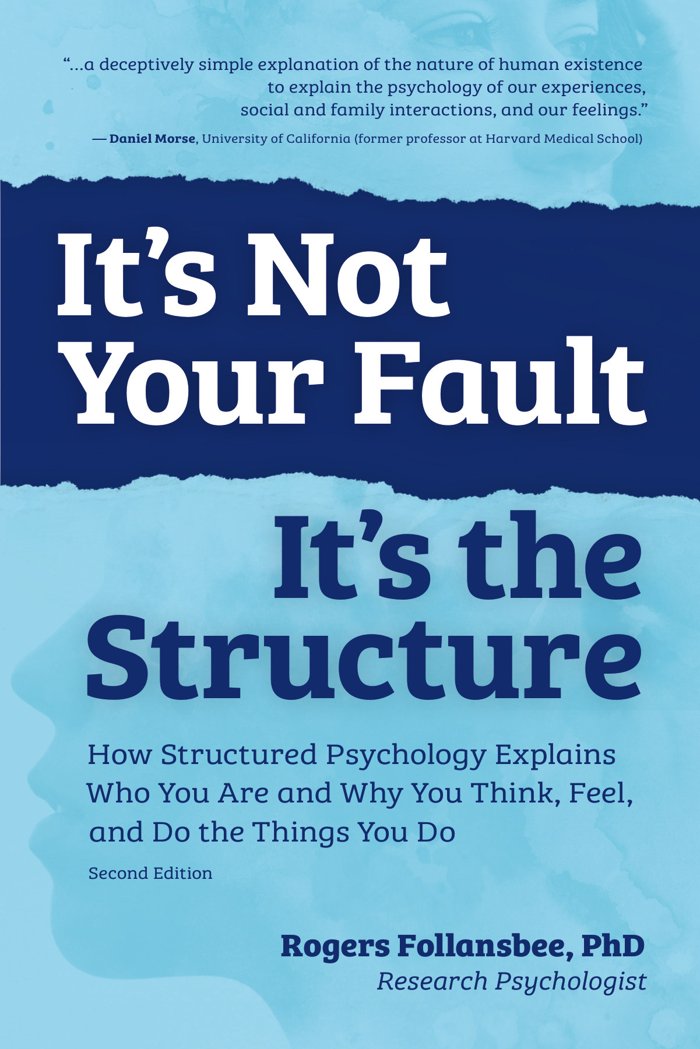
Choose your bundle
Each bundle has three parts that work together. You read the book, you practice with the Companion Workbook, and you bring your own moments to the Relationship Translator.
The paperback bundle
$47
- The second-edition paperback, mailed to you
- The printed Companion Workbook, the same size as the book
- The Relationship Translator app, open as soon as you order
The digital bundle
$37
- The second-edition ebook
- The Companion Workbook as a PDF
- The Relationship Translator app, open as soon as you order
You can also start with one piece: try the Translator free for 14 days, or buy the paperback on Amazon for $19.99.
You're in a café. Two lovers at the next table are working up to a real fight. A man walks in, trips, and checks to see who noticed. In the corner, a woman in a wedding dress sits alone with a hot drink and red-rimmed eyes.
She catches you staring. You smile, raise your mug, and wish you hadn't.
"Why did I just do that?"
Rogers Follansbee has an answer to that question, and to the lovers, and to the man who tripped. The same answer covers all three, and it covers you.
What Rogers found
In 1974, at the Universidad de Navarra in Spain, Rogers defended a doctoral dissertation on a theory he called Relationability. He had set out to study Anna Freud's defense mechanisms. He came out with something larger: a set of relational rules underneath them, which he calls the Structure.
He has spent the fifty years since testing those rules, and psychology has spent the same decades moving toward relational models of the mind. The book is his full account of what he found, written for readers who want the reasoning and the evidence along with the conclusions.
The central idea is simple to state. You exist through your relationships with people, places, and things. When a relationship confirms you, you feel steady. When it contradicts you, you feel unsteady, and you do something to recover. Most of what we call personality, and much of what we call our problems, follows from those moments.
That is why the title says what it says. Your reactions follow a logic you didn't choose. Once you can see that logic, you can choose what to do next.
What you'll find inside
- Why contradictions knock you off balance. Chapter 4 maps the different shapes a contradiction takes, from a partner's sigh to a stranger's cut in line.
- What you do to recover, and why. Chapters 5 and 6 explain damage control and defensiveness: fight, flight, freeze, fawn, and the logic that picks one.
- Why your self-image isn't fully yours to set. Chapter 7 answers "Who am I?" through the people and things you relate to.
- How the Structure plays out in families, workplaces, and society. Chapter 8 takes the theory out of the café and into the wider world.
- Where your power lies. Chapter 9 turns the theory into choices you can make on Monday morning.
Every chapter closes with a sidebar from co-writer Leah Donell, who connects the theory to topics you already know, plus exercises you can try in your own relationships.
The companion app
Bring the book into your own relationships.
Reading about the Structure is one thing. Seeing it in your own Tuesday night is another. The Relationship Translator is a companion app built on the full text of the book.
You pick a person (a partner, a parent, a coworker, a friend) and describe what happened. A guide in Rogers's voice asks a few questions, then shows you the moment through the book's lens: what was affirmed, what was contradicted, and why your reaction made sense. When a story from the book fits, the guide points you to the chapter so you can read the whole thing.
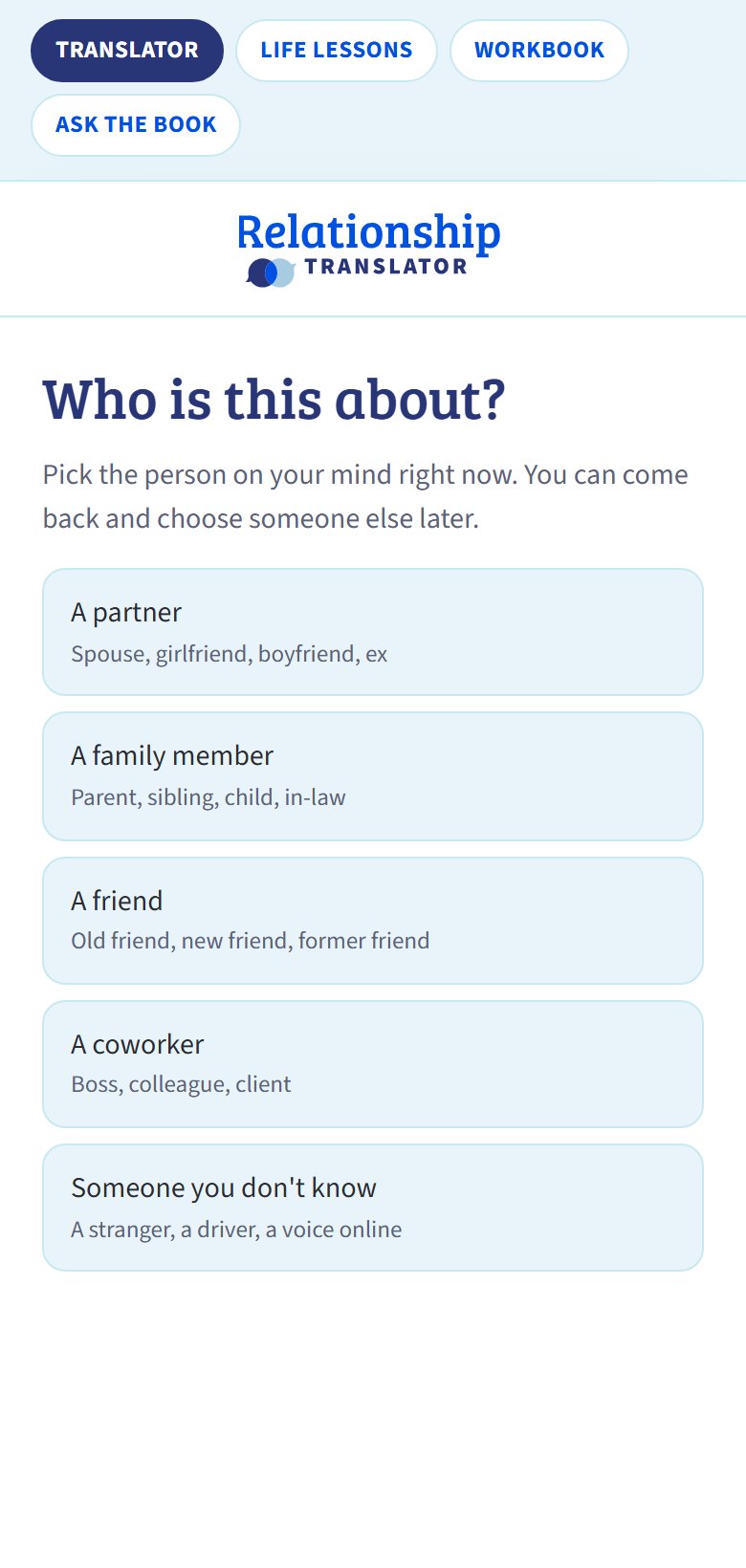
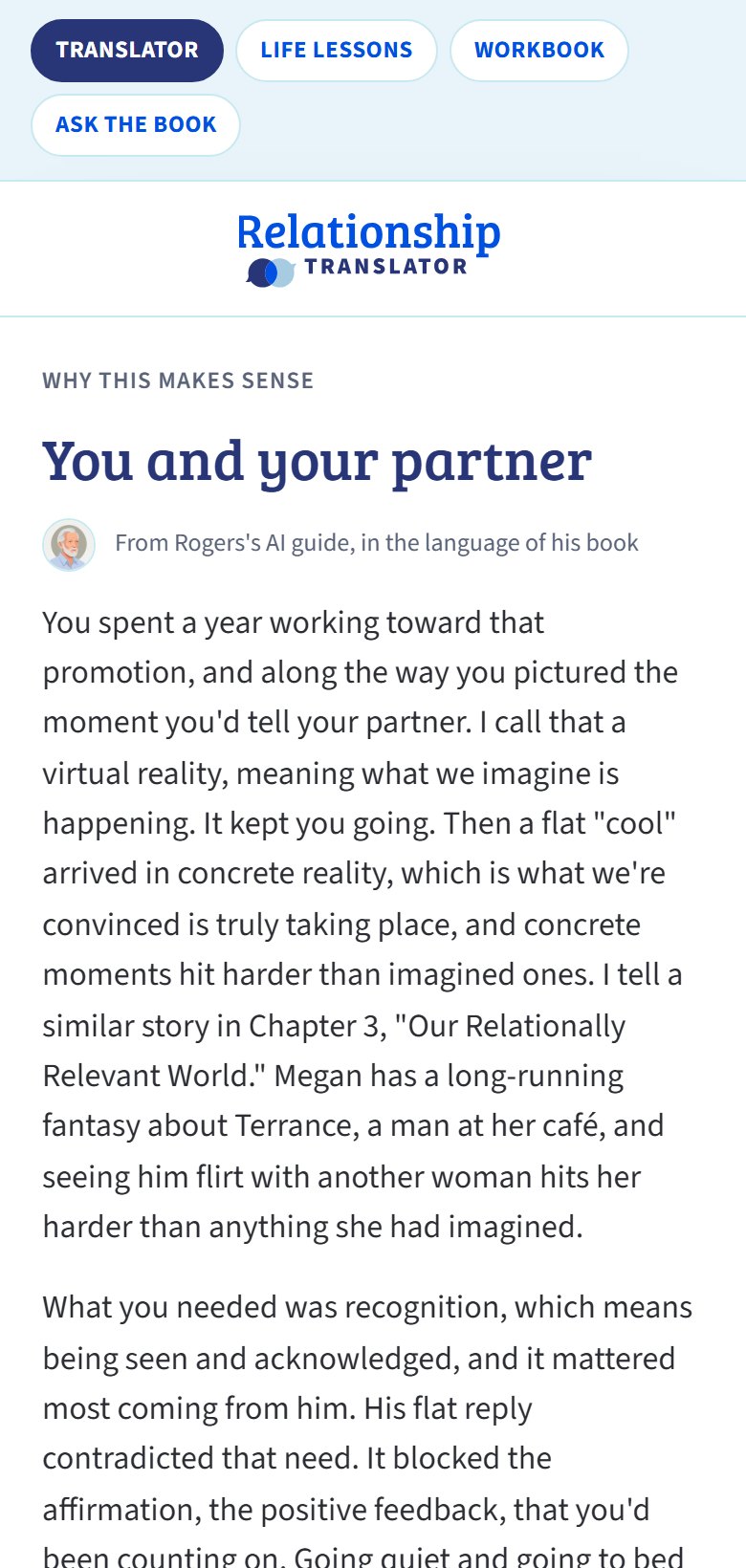
Translator
Talk through one moment with one person.
Life Lessons
Pick a bigger question and work through it the same way.
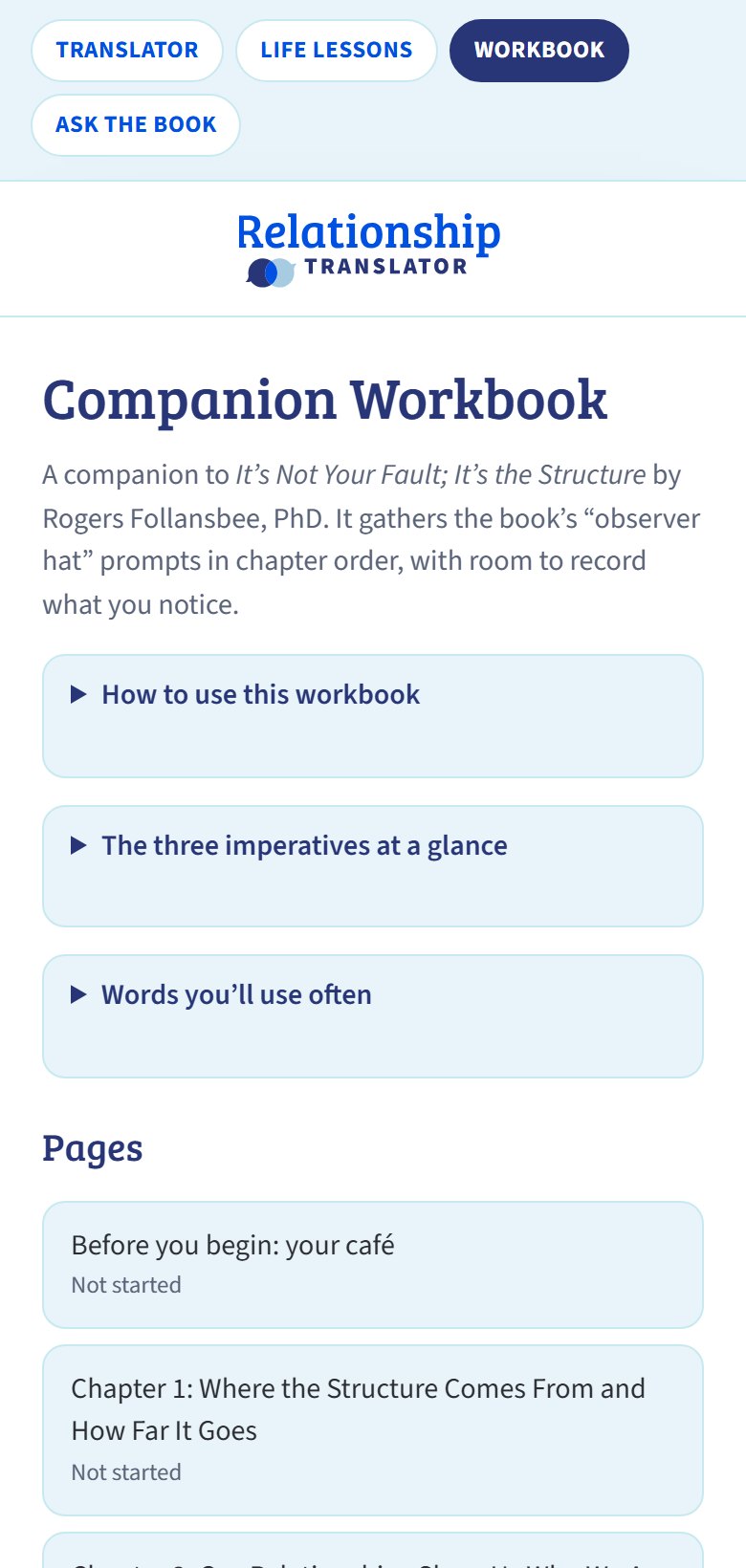
Companion Workbook
Work through the book chapter by chapter, with room to record what you notice in your own relationships.
Ask the book
Ask anything about Structured Psychology and get an answer from the text.
What it is and isn't. The guide is an AI that speaks in Rogers's voice and says only what the book says. It gives no advice and no diagnosis, and it tells you it's an AI if you ask. Your conversations stay in your own browser; the app saves nothing on its server.
You can try the Translator free for 14 days, or get it with the book and the workbook in either bundle.
What readers say
Praise for the first edition
"In down-to-earth, readily understandable plain English, It's Not Your Fault starts from a deceptively simple explanation of the nature of human existence to explain the psychology of our experiences, social and family interactions, and our feelings. ... As a teacher for more than 50 years, I'd love to see this enjoyable and clear path to understanding ourselves and our interactions become required reading for high school seniors."
Daniel Morse, University of California (former professor at Harvard Medical School)
"It's Not Your Fault gave me language for things I've felt for years but couldn't explain. ... I kept thinking, 'Ohhh, that's why I do that.'"
Abbie Gripman, Editor, Arizona State University
"A masterfully crafted book, underpinned by science and written so eloquently and clearly so as to help the reader interpret, digest and navigate life through a deeper understanding of 'Self.'"
Sarina Paul, Corporate Training Executive
About the author
Rogers Follansbee, PhD, is a research psychologist. He earned a master's degree in clinical psychology from the Universidad de Madrid in 1971, taught the history of psychology and psychodiagnostics at the Universidad de Navarra, and defended his dissertation there in 1974 with a summa cum laude qualification. He moved to the United States in 1980 and has developed Structured Psychology ever since. He and his wife, Carmen, divide their time between northern Spain and southern California.
Leah Donell is the book's co-writer and editor. Her sidebars, signed "your structural tour guide," close each chapter.
Questions
Is this a self-help book?
It's a theory of behavior, written for anyone. Rogers explains why we do what we do, and leaves the choices to you. The exercises and Leah's sidebars help you apply it.
Is it therapy?
No. It's a way of understanding yourself and the people around you. If you're in crisis, call or text 988 in the US.
What changed in the second edition?
A new title, a reorganized structure, clearer explanations of the core ideas, new sidebars from Leah Donell, and a fresh set of chapter exercises.
How do I get the Relationship Translator?
The Translator comes with both bundles. You can also try it free for 14 days: add your name and email, and we'll send you a link to the app.
Where can I learn more about Structured Psychology?
Rogers explains the ideas in short videos on the Structured Psychology YouTube channel. For longer answers about the method, including whether a structured self leaves you responsible for your actions, read the Structured Psychology FAQ.
Start with your own café.
Try the Relationship Translator free for 14 days. Pick one person, describe one moment, and see it through the book's ideas. Add your name and email, and we'll send you a link to the app. The Companion Workbook comes with your trial as a free PDF.
Thank you.
Your link to the Relationship Translator and your Companion Workbook PDF are on their way to your inbox.
Or get the book, the workbook, and the app together in a bundle.